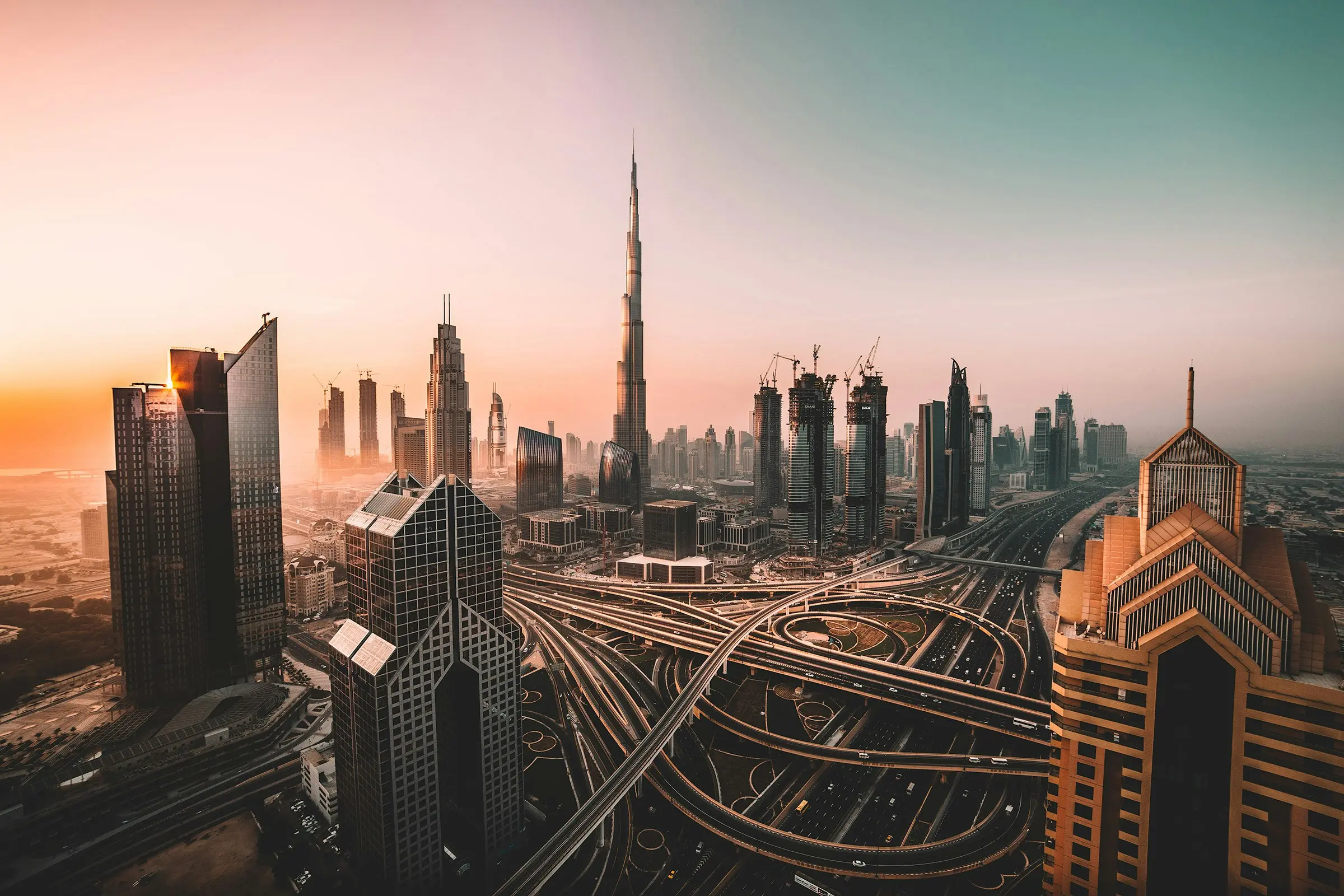
Dubai Real Estate Crash or Correction 2026: A Data-Driven Analysis
Is Dubai property heading for a crash or a healthy correction in 2026? Data-driven analysis covering supply pipeline, demand fundamentals, historical comparisons, and investor implications.

Key Takeaways
- Dubai's real estate market is experiencing a correction, not a crash in 2026. Growth rates are moderating from unsustainable double-digit surges to a healthier 5–8% annual pace.
- Historical crash conditions do not exist. The 2008 crash was driven by rampant speculation, weak regulation, and excessive leverage — none of which characterise today's market.
- Supply is the primary risk, but it is concentrated in mid-market apartments. Villa and ultra-prime segments remain supply-constrained and continue to appreciate at 10–18% annually.
- Demand fundamentals are strong. Population growth of 5–6% annually, diversification across 150+ buyer nationalities, Golden Visa demand, and rising end-user participation provide a solid demand base.
- Geopolitical risk is a double-edged sword. Regional instability can cause short-term disruption but also drives safe-haven capital into Dubai, as demonstrated repeatedly since 2020.
- Investors should be selective, not fearful. Quality assets in supply-constrained segments remain excellent investments. Mid-market apartment exposure should be reviewed for concentration risk.
- URL: https://aigents-realty-images.b-cdn.net/blogs_images/dubai-real-estate-crash-or-correction-2026-section2.jpg | Alt: Modern Dubai residential towers and villa communities side by side, illustrating the evolution of Dubai real estate from past market cycles to the current 2026 correction | Section: Historical Crash Comparison: What Actually Happened | Position: after_heading
- URL: https://aigents-realty-images.b-cdn.net/blogs_images/dubai-real-estate-crash-or-correction-2026-section3.jpg | Alt: Active construction site with cranes building new residential towers in Dubai, representing the 2026 supply pipeline of 38,000–42,000 residential units | Section: Supply Pipeline: The Most Cited Risk | Position: after_heading
- URL: https://aigents-realty-images.b-cdn.net/blogs_images/dubai-real-estate-crash-or-correction-2026-section4.jpg | Alt: Luxury Dubai villa with private pool alongside modern high-rise apartment building, showing the different real estate segments and their varying risk profiles in the 2026 Dubai property correction | Section: The Segment-by-Segment Reality | Position: after_heading
Every few months, the same question resurfaces in Dubai property circles: is the market about to crash? The concern is understandable. Dubai has experienced dramatic booms and busts before. Prices have been rising for four consecutive years. Supply deliveries are accelerating. And every investor remembers 2008.
But asking whether Dubai real estate is crashing is the wrong question. The right question is: what kind of market transition is underway, and what does the data actually show?
This analysis examines the evidence — supply pipeline numbers, demand fundamentals, historical crash comparisons, price-to-income ratios, and geopolitical risk factors — to determine whether 2026 represents a market crash, a healthy correction, or something else entirely. For the latest transaction data and price movements, see our Dubai property market update for May 2026.
The Short Answer: Correction, Not Crash
Based on current data, Dubai's real estate market in 2026 is experiencing a gradual correction and normalisation, not a crash. The distinction matters enormously for investors.
A crash implies a rapid, broad-based decline of 20% or more across most segments, typically triggered by leverage unwinding, liquidity crises, or fundamental demand collapse. A correction involves moderating growth rates, selective price softening in oversupplied segments, and a return to sustainable price appreciation — while the overall market continues to grow.
The data supports the latter. Dubai recorded over 45,000 real estate transactions in Q1 2026, with total value exceeding AED 114 billion — a 5.1% increase in volume and 8.6% increase in value year-on-year. Q2 2026 is tracking above Q1, with April and May transaction volumes up approximately 6% year-on-year. These are not the numbers of a crashing market.
However, growth rates are decelerating. After several years of double-digit annual appreciation, price growth has moderated to 5–10% for apartments and 12–18% for villas. Rental growth has decelerated from 15–20% annual increases in 2024 to 5–8% in Q2 2026. This is the market self-correcting — and that is a fundamentally different phenomenon from a crash.
Historical Crash Comparison: What Actually Happened

To understand why 2026 is different, it is essential to examine what actual crashes looked like in Dubai's history.
The 2008–2010 Crash: The Benchmark
The 2008 crash was catastrophic by any measure. Dubai property prices fell 50–60% from peak to trough between Q3 2008 and Q1 2010. Some off-plan projects lost 70% of their value. Multiple developments were abandoned. The crash was driven by a confluence of factors that simply do not exist today:
| Factor | 2008 | 2026 |
|---|---|---|
| Off-plan speculation | Rampant — 60%+ of transactions were speculative flips | Controlled — DLD requires 30% minimum payment before resale |
| Leverage | High — 85–90% LTV mortgages were common | Moderate — LTV capped at 75–80% for expats, 50% for off-plan |
| Developer regulation | Weak — minimal escrow enforcement | Strong — RERA escrow accounts, project completion guarantees |
| Demand base | Narrow — dominated by speculative capital | Diversified — 150+ nationalities, end-user demand rising |
| Global context | Global financial crisis, credit freeze | Post-pandemic recovery, capital flowing into safe havens |
| Supply pipeline | Massive — 60,000+ units planned for delivery | Elevated but managed — 38,000–42,000 units in 2026 |
The 2008 crash was amplified by structural weaknesses in Dubai's market that have since been addressed. RERA's escrow account regulations, introduced in 2008 and progressively strengthened, ensure that developer funds are ring-fenced for construction — a key protection explored in our Dubai tenant rights and RERA protection guide. The DLD's 30% minimum payment rule for off-plan resales, reinforced in February 2026, has reduced speculative flipping from approximately 15% of off-plan transactions in early 2025 to under 8% in Q2 2026.
The 2014–2016 Correction
The 2014 downturn was milder — a 10–15% price decline over 18 months, driven primarily by the oil price collapse and a strong US dollar (which made dirham-denominated assets more expensive for many foreign buyers). This was a correction, not a crash. The market recovered by 2017, and key structural factors — population growth, infrastructure investment, regulatory reform — remained positive throughout.
The 2014 episode is more analogous to the current environment than 2008. Like today, the market had experienced several years of rapid appreciation (2012–2014), supply was increasing, and external factors (oil prices then, interest rates now) were creating headwinds. The correction was painful for overleveraged buyers but healthy for the market's long-term sustainability.
The 2020 Pandemic Shock
The 2020 pandemic caused a brief but sharp disruption — transaction volumes fell 15–20% in Q2 2020, and prices dipped 5–10% in most segments. But the recovery was remarkably swift. By Q2 2021, transaction volumes had surpassed pre-pandemic levels, and Dubai's handling of the pandemic — rapid vaccination, open borders, business-friendly policies — converted a crisis into an opportunity, attracting a wave of new residents and capital.
The 2020 episode demonstrated Dubai's resilience. The market's ability to absorb a global shock and emerge stronger within 12 months speaks to the structural demand underpinnings that distinguish today's market from 2008.
Supply Pipeline: The Most Cited Risk

The most common argument for an imminent crash is supply. Dubai is delivering more residential units in 2026 than at any point since 2014, and the pipeline for 2027–2028 is even larger.
Current Supply Numbers
According to CBRE's Q1 2026 Dubai Market Overview, approximately 9,500 residential units were delivered in Q1 2026, with a further 10,000–12,000 expected in Q2. The full-year 2026 delivery forecast stands at 38,000–42,000 units — up from approximately 35,000 in 2025.
Key areas receiving new supply in 2026:
| Area | 2026 Expected Units | Primary Segment |
|---|---|---|
| JVC | 5,000+ | Mid-market apartments |
| Dubai Hills Estate | 2,800+ | Premium apartments & villas |
| Business Bay | 2,200+ | Premium apartments |
| Dubai Creek Harbour | 1,500+ | Premium apartments |
| Dubai South | 2,000+ | Affordable apartments |
| Arjan | 1,800+ | Mid-market apartments |
| Other areas | 22,000+ | Mixed |
The 2027–2028 pipeline is larger still, with some estimates projecting 45,000–55,000 units per year. This is the data point that worries analysts.
Why Supply Alone Does Not Equal a Crash
Supply is a necessary but insufficient condition for a crash. The critical question is whether demand can absorb the new units. On this measure, the evidence is cautiously positive:
- Absorption rates remain healthy. Most new buildings report 70–80% occupancy within 6 months of handover. This is not the pattern of a market drowning in oversupply.
- Population growth continues. Dubai's population grew by approximately 5.7% in 2025, adding over 200,000 new residents. Even conservative population growth projections suggest demand for 30,000–40,000 residential units annually.
- The supply is concentrated, not uniform. The bulk of new deliveries are in mid-market apartments (JVC, Arjan, Dubai South). Villa supply remains constrained, which is why villa prices continue to appreciate at 12–18% annually. The market is not uniformly oversupplied — it is selectively oversupplied in specific segments. For a deeper look at one of the highest-supply areas, see our JVT investment guide 2026.
- End-user demand is rising. The proportion of ready-property purchases by end-users has increased from approximately 45% in 2024 to an estimated 52% in Q2 2026, according to Property Finder's demand index. End-users are less likely to sell in a downturn than investors, providing price stability.
The supply risk is real but segment-specific. Mid-market apartments in areas with heavy deliveries (JVC, Arjan, Dubai South) will likely see price growth slow to 3–6% annually and may experience brief periods of flat or slightly declining prices. Premium apartments and villas in supply-constrained areas (Palm Jumeirah, Dubai Hills Estate, Arabian Ranches) are likely to continue appreciating.
Demand Fundamentals: The Counterweight
If supply is the bear case, demand is the bull case. And the demand data is compelling.
Population and Residency Growth
Dubai's population surpassed 3.8 million in early 2026 and is growing at approximately 5–6% annually. The emirate added over 200,000 new residents in 2025 alone. This growth is driven by:
- Golden Visa programme. The 10-year residency visa for property investors purchasing units valued at AED 2 million or more continues to attract foreign capital. Golden Visa-eligible transactions accounted for approximately 28% of all foreign buyer deals in Q1 2026, up from 24% in Q1 2025.
- Corporate expansion. Dubai's free zones added over 15,000 new company registrations in 2025, each bringing employees who need housing.
- Lifestyle migration. Remote work policies, zero income tax, and world-class infrastructure continue to attract professionals from Europe, Asia, and the Americas.
Foreign Investment Flows
Dubai's appeal to international investors shows no signs of diminishing in 2026:
| Nationality | Share of Foreign Transactions | YoY Change |
|---|---|---|
| Indian | 20% | +3% |
| British | 12% | +5% |
| Chinese | 9% | +22% |
| Russian | 7% | -8% |
| Pakistani | 6% | +4% |
| French | 5% | +7% |
| German | 4% | +12% |
Chinese investment is the standout trend — a 22% year-on-year increase driven by eased capital outflow restrictions and growing confidence in Dubai's regulatory framework. British and European demand is also rising, reflecting Dubai's status as a wealth haven amid global uncertainty.
Mortgage Market Dynamics
Approximately 35% of Dubai property transactions currently involve a mortgage — a figure that could rise to 40% if the Federal Reserve cuts interest rates in H2 2026 (the UAE dirham is pegged to the US dollar, so local rates follow the Fed). For a full breakdown of financing options and current rates, see our Dubai property mortgage guide 2026. This is significant because:
- Low leverage reduces crash risk. In 2008, mortgage penetration was higher and LTV ratios were more aggressive. Today's lower leverage means fewer forced sellers in a downturn.
- Rate cuts could stimulate demand. If mortgage rates decline by 50–75 basis points in H2 2026, financed purchases become more attractive, potentially offsetting any demand softness from supply absorption.
Price-to-Income Ratios: Overvalued or Fair?
One of the most cited metrics in crash predictions is the price-to-income ratio — how many years of average income it takes to buy an average property. Critics argue that Dubai's ratios are stretched.
The data tells a more nuanced story. Dubai's price-to-income ratio for residential property is estimated at 8–10x for apartments and 12–15x for villas in 2026. This is elevated compared to historical Dubai norms (6–7x in 2019) but remains competitive with other global gateway cities:
| City | Price-to-Income Ratio (2026 est.) |
|---|---|
| Hong Kong | 20–25x |
| London | 12–16x |
| Singapore | 12–15x |
| Dubai | 8–10x (apartments) |
| New York | 10–14x |
| Sydney | 9–12x |
Dubai's ratio is actually lower than most comparable cities, which is remarkable given the zero income tax advantage. A buyer in Dubai earning AED 300,000 annually and purchasing an AED 2.5 million apartment faces an 8.3x ratio — but their after-tax income is significantly higher than a London or New York earner on an equivalent gross salary.
The price-to-income metric also fails to capture Dubai's unique demand dynamics. A significant proportion of buyers are foreign investors purchasing with cash or capital from overseas — their income is not captured in local income statistics, making the ratio appear worse than the actual affordability picture.
Geopolitical Risk Factors
Dubai's geopolitical position is a double-edged sword. Regional instability can both threaten and benefit the emirate's property market.
Risks
- Regional escalation. Any significant escalation in the Middle East — whether involving Iran, the broader Israel-Palestine conflict, or Gulf state tensions — could temporarily deter foreign investment and tourism. Dubai's property market experienced brief dips during regional crises in 2019 (Abqaiq–Khurais attack) and 2024 (Red Sea shipping disruptions), though both recoveries were swift.
- Oil price volatility. A sustained decline in oil prices below $50/barrel would reduce Gulf government spending and potentially slow intra-regional investment flows into Dubai property.
- Global recession. A significant economic downturn in China, Europe, or the US would reduce foreign capital inflows. Chinese buyers, now the third-largest foreign investor group, are particularly sensitive to domestic economic conditions.
Safe-Haven Dynamics
Crucially, geopolitical risk also drives capital into Dubai. The emirate's political stability, neutral diplomatic stance, and world-class infrastructure make it a preferred destination for wealth preservation during periods of global uncertainty. This safe-haven dynamic was evident during the Russia-Ukraine conflict, the 2023 banking crisis, and ongoing Middle East tensions — in each case, Dubai property demand increased as investors sought stability.
The net effect of geopolitical risk on Dubai property is therefore ambiguous. Short-term disruptions are possible, but the structural trend favours Dubai as a beneficiary of global uncertainty.
The Segment-by-Segment Reality

The crash-versus-correction debate often treats "Dubai real estate" as a monolith. It is not. Different segments face very different risk profiles in 2026.
| Segment | Crash Risk | Correction Risk | 2026 Outlook |
|---|---|---|---|
| Mid-market apartments (JVC, Arjan, Dubai South) | Low | Moderate | 3–6% growth; possible flat periods |
| Premium apartments (Marina, Downtown, Creek Harbour) | Very Low | Low | 5–8% growth; supply-constrained |
| Villas/Townhouses (Hills, Ranches, Tilal Al Ghaf) | Very Low | Very Low | 12–18% growth; severe supply constraints |
| Ultra-prime (Palm, Emirates Hills, Jumeirah Bay) | Very Low | Very Low | 10–15% growth; global UHNWI demand |
| Off-plan (speculative) | Low-Moderate | Moderate | Flipping returns compressed; hold strategy preferred |
| Off-plan (end-user) | Very Low | Low | Payment plan flexibility offsets risk |
The segments most vulnerable to correction are mid-market apartments in oversupplied areas and speculative off-plan purchases. The segments least vulnerable are villas, ultra-prime properties, and end-user off-plan purchases with manageable payment plans.
What Would Actually Cause a Crash?
For a genuine crash — a 20%+ broad-based decline — several conditions would need to converge simultaneously:
-
A global credit crisis similar to 2008, causing liquidity to evaporate and forced selling to cascade. Current banking regulations and capital requirements make this significantly less likely than in 2008.
-
A massive oversupply shock with 60,000+ units delivered in a single year into weakening demand. Current delivery projections of 38,000–42,000 units in 2026 are well below this threshold, and absorption rates remain healthy.
-
A collapse in foreign investment driven by a severe global recession or major geopolitical crisis that specifically targets UAE financial channels. Dubai's diversification across 150+ buyer nationalities provides meaningful insulation.
-
Regulatory failure — a breakdown in RERA escrow protections, DLD oversight, or developer compliance that erodes buyer confidence. There is no evidence of this; if anything, regulation is tightening.
None of these conditions are present in 2026. The probability of a crash is low. The probability of a continued, gradual correction in oversupplied segments is moderate to high — and that correction is healthy, not dangerous.
Investment Implications: What Should Investors Do?
For investors, the crash-or-correction distinction has direct portfolio implications.
If You Are Already Invested
- Hold quality assets. Villas in established communities, premium apartments in supply-constrained areas, and ultra-prime properties are likely to continue appreciating. There is no reason to sell.
- Review mid-market apartment exposure. If you hold multiple mid-market apartments in JVC, Arjan, or Dubai South, consider whether your portfolio is over-concentrated in the segment most vulnerable to price moderation. Diversification into villa or premium segments may reduce risk.
- Monitor rental yields. As property prices have risen faster than rents, gross yields have compressed from 7–9% in 2023 to 5.5–7.5% in Q2 2026 for apartments. Ensure your net yields still meet your investment criteria after service charges and maintenance.
If You Are Considering Buying
- Villas and townhouses remain the strongest play. Supply constraints and family demand support 10–15% annual appreciation in communities like Dubai Hills Estate, Tilal Al Ghaf, and Arabian Ranches. For premium real estate in the heart of the city, see our Downtown Dubai luxury investment guide 2026.
- Be selective with mid-market apartments. Focus on buildings with strong developer track records, proximity to metro stations, and community amenities that differentiate them from the flood of generic mid-market supply.
- Off-plan is best with a hold strategy. The DLD's 30% minimum payment rule has compressed flipping returns. Off-plan is most attractive for buyers with a 2–4 year investment horizon who can benefit from payment plan flexibility and completion appreciation. For a full walkthrough of the purchase process, see our step-by-step guide to buying property in Dubai.
- Consider the interest rate outlook. If the Fed cuts rates in H2 2026, mortgage affordability improves and demand from financed buyers increases. This could be a catalyst for renewed price growth, particularly in the mid-market segment.
Frequently Asked Questions
Is the Dubai property market going to crash in 2026? Based on current data, a crash is unlikely. The market is experiencing a gradual correction and normalisation, with growth rates moderating from the double-digit surges of 2023–2024 to a more sustainable 5–8% annual pace. Transaction volumes remain strong, demand fundamentals are solid, and regulatory safeguards are stronger than in previous downturns.
What is the difference between a crash and a correction? A crash involves a rapid, broad-based price decline of 20% or more, typically triggered by leverage unwinding or demand collapse. A correction involves moderating growth rates and selective price softening in specific segments, while the overall market continues to grow. Dubai in 2026 fits the correction profile.
Which areas are most at risk of price declines? Mid-market apartments in areas with heavy supply deliveries — JVC, Arjan, and Dubai South — are most vulnerable to price growth moderation and potential brief periods of flat or slightly declining prices. Premium apartments and villas in supply-constrained areas are significantly less at risk.
How does the 2026 market compare to 2008? The 2026 market is fundamentally different from 2008. Key differences include: stronger regulation (RERA escrow accounts, DLD resale restrictions), lower leverage (mortgage LTV caps at 75–80% versus 85–90% in 2008), more diversified demand (150+ buyer nationalities versus a narrower base), and higher end-user participation (52% versus approximately 35% in 2008). For more on ownership protections, see our Dubai title deed guide 2026.
Should I sell my Dubai property now? For quality assets — villas in established communities, premium apartments in supply-constrained areas — there is no compelling reason to sell. These segments continue to appreciate. For mid-market apartments in oversupplied areas, consider whether your portfolio is over-concentrated and whether diversification might reduce risk.
Is off-plan still a good investment? Off-plan remains attractive for buyers with a 2–4 year investment horizon who can benefit from flexible payment plans and completion appreciation. However, speculative flipping returns have compressed due to the DLD's 30% minimum payment rule. Off-plan is best approached as a hold strategy, not a quick flip.
What role does the Golden Visa play in market stability? The Golden Visa programme — granting 10-year residency for AED 2 million+ property purchases — is a significant demand stabiliser. Approximately 28% of foreign buyer transactions in Q1 2026 qualified for the Golden Visa. These buyers are typically long-term holders, not speculators, which adds stability to the market.
How do Dubai property prices compare to other global cities? Dubai's price-to-income ratio of 8–10x for apartments is lower than Hong Kong (20–25x), London (12–16x), Singapore (12–15x), and Sydney (9–12x). When adjusted for Dubai's zero income tax, affordability is even more competitive. Dubai remains one of the best value global gateway cities for property investment.
Key Takeaways
- Dubai's real estate market is experiencing a correction, not a crash in 2026. Growth rates are moderating from unsustainable double-digit surges to a healthier 5–8% annual pace.
- Historical crash conditions do not exist. The 2008 crash was driven by rampant speculation, weak regulation, and excessive leverage — none of which characterise today's market.
- Supply is the primary risk, but it is concentrated in mid-market apartments. Villa and ultra-prime segments remain supply-constrained and continue to appreciate at 10–18% annually.
- Demand fundamentals are strong. Population growth of 5–6% annually, diversification across 150+ buyer nationalities, Golden Visa demand, and rising end-user participation provide a solid demand base.
- Geopolitical risk is a double-edged sword. Regional instability can cause short-term disruption but also drives safe-haven capital into Dubai, as demonstrated repeatedly since 2020.
- Investors should be selective, not fearful. Quality assets in supply-constrained segments remain excellent investments. Mid-market apartment exposure should be reviewed for concentration risk.
Data sources: Dubai Land Department (DLD), ValuStrat, CBRE, Property Finder, Knight Frank. Transaction data reflects DLD records through May 2026. Historical crash data sourced from DLD archives and CBRE market reports. Forecasts are based on current trajectories and may change based on macroeconomic conditions.
Frequently Asked Questions
Is the Dubai property market going to crash in 2026?
Based on current data, a crash is unlikely. The market is experiencing a gradual correction and normalisation, with growth rates moderating from the double-digit surges of 2023–2024 to a more sustainable 5–8% annual pace. Transaction volumes remain strong, demand fundamentals are solid, and regulatory safeguards are stronger than in previous downturns.
What is the difference between a crash and a correction?
A crash involves a rapid, broad-based price decline of 20% or more, typically triggered by leverage unwinding or demand collapse. A correction involves moderating growth rates and selective price softening in specific segments, while the overall market continues to grow. Dubai in 2026 fits the correction profile.
Which areas are most at risk of price declines?
Mid-market apartments in areas with heavy supply deliveries — JVC, Arjan, and Dubai South — are most vulnerable to price growth moderation and potential brief periods of flat or slightly declining prices. Premium apartments and villas in supply-constrained areas are significantly less at risk.
How does the 2026 market compare to 2008?
The 2026 market is fundamentally different from 2008. Key differences include: stronger regulation (RERA escrow accounts, DLD resale restrictions), lower leverage (mortgage LTV caps at 75–80% versus 85–90% in 2008), more diversified demand (150+ buyer nationalities versus a narrower base), and higher end-user participation (52% versus approximately 35% in 2008).
Should I sell my Dubai property now?
For quality assets — villas in established communities, premium apartments in supply-constrained areas — there is no compelling reason to sell. These segments continue to appreciate. For mid-market apartments in oversupplied areas, consider whether your portfolio is over-concentrated and whether diversification might reduce risk.
Is off-plan still a good investment?
Off-plan remains attractive for buyers with a 2–4 year investment horizon who can benefit from flexible payment plans and completion appreciation. However, speculative flipping returns have compressed due to the DLD's 30% minimum payment rule. Off-plan is best approached as a hold strategy, not a quick flip.
What role does the Golden Visa play in market stability?
The Golden Visa programme — granting 10-year residency for AED 2 million+ property purchases — is a significant demand stabiliser. Approximately 28% of foreign buyer transactions in Q1 2026 qualified for the Golden Visa. These buyers are typically long-term holders, not speculators, which adds stability to the market.
How do Dubai property prices compare to other global cities?
Dubai's price-to-income ratio of 8–10x for apartments is lower than Hong Kong (20–25x), London (12–16x), Singapore (12–15x), and Sydney (9–12x). When adjusted for Dubai's zero income tax, affordability is even more competitive. Dubai remains one of the best value global gateway cities for property investment.
Editorial Team
AiGentsRealtyThe AiGentsRealty editorial team consists of real estate experts, market analysts, and property consultants with over 20 years of combined experience in the Dubai real estate market.
Related Articles
AI Real Estate Investing: How Smart Investors Use AI in 2026
Discover how AI is transforming real estate investment in 2026 — from predictive market analysis and automated deal sourcing to AI-assisted due diligence and portfolio optimization.
Market NewsSmart Homes 2026: How AI and IoT Are Reshaping Property Value
Smart home features now command 3-5% price premiums and 5-15% higher rents. Explore the AI and IoT technologies driving property value in 2026 and how to invest wisely.
Market NewsReal Estate Automation Trends: What is Changing in 2026
From autonomous transaction management to predictive portfolio optimization — the 5 automation trends reshaping real estate in 2026 and how to prepare your business.
Ready to Invest in Dubai?
Get personalized investment recommendations from our AI advisor based on your budget, goals, and preferences.
Ask Sophia AI